


Hello brothers and sisters,
Three pieces in, and we’ve covered more ground than I expected when Kevin and I first sat down to plan this out.
In part one, Kevin and I walked into Genesis 14 together and found a war. Four kings out of the east, five kings of the plain, a rebellion one year old, and a campaign that rolled through the Transjordan putting down clan after clan: Rephaim, Zuzim, Emim, Horites, before Sodom ever fell. Then Lot was taken, and a man with three hundred eighteen members of his own household went after an empire and won.
In part two, I asked who those clans actually were. Rephaim, Anakim, Emim, Zamzummim, Zuzim, one phenomenon under five regional names, and Kevin went after the one word holding them together, Rephaim itself, tracing how the Greek translators couldn’t agree on what to do with it. Giants in one place. Titans in another. The earth-born. Physicians. Sometimes they just transliterated the sound and left it unexplained.
In part three, we finally reached the man this whole series had been circling since Genesis 14’s first verse. I took the scene itself, four short verses, bread and wine, a blessing that reframed the entire war, a tithe handed to a stranger, and argued that what Genesis refuses to tell us about him, no father, no mother, no tribe, is the actual point. Kevin picked it up from there, laid out every serious answer anyone has given to who Melchizedek was, including a couple you’ve probably never heard, took us into the Greek of Psalm 110, and landed in Hebrews 7, where an entire doctrine of Christ’s eternal priesthood gets built on a man who appears for four verses and vanishes.
If you haven’t read those three yet, start there. This one will make a lot more sense once you have.
Today we go back to a thread I left open at the end of part two: Og, king of Bashan, the last of the remnant, and a question about his bed I deliberately didn’t answer when I first raised it. Nine cubits by four, iron, on display at Rabbah long after he was gone. Furniture sized for an enormous man, or something else wearing that description?
I’m answering that today, and taking you to the Golan plateau to do it. Then Kevin picks up where the Greek translators made a decision about Og’s name they refused to make anywhere else in this whole word study, and from there we go to Gath. To the most famous giant in the Bible, to a potsherd pulled out of the ground in 2005 with his name scratched into it, and to a measurement your Bible almost certainly gets wrong. Then four more giants, a king too weary to fight his own battles anymore, and a single verse in 2 Samuel that appears to say somebody other than David killed Goliath.
The remnant Moses declared finished in Deuteronomy 3 wasn’t finished. This is the piece where we find out what that means.
Let’s get into it.
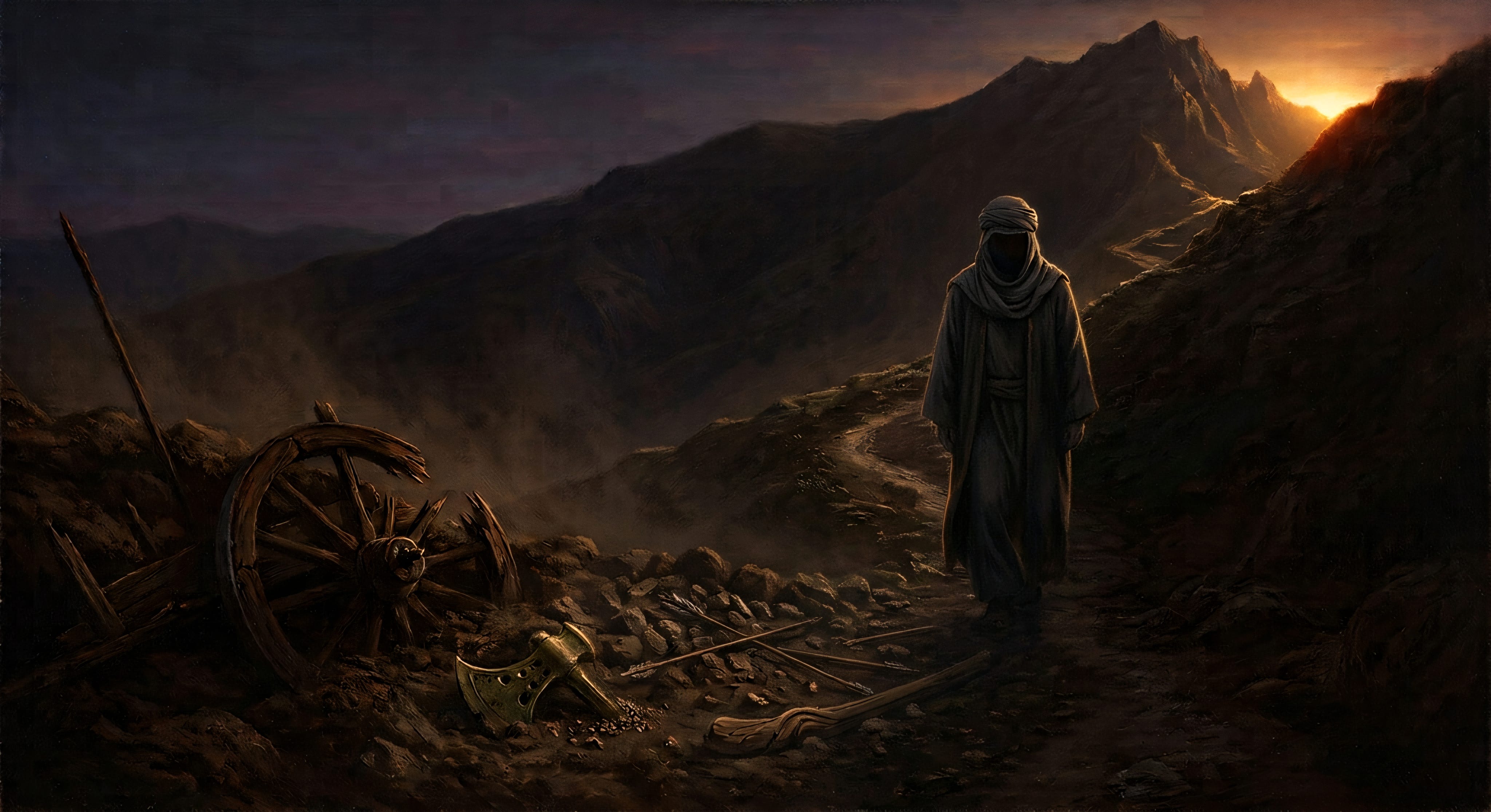
Lawrence: The Last of the Remnant
Back in the piece on who the Rephaim actually were, I flagged something and left it alone on purpose. The iron bedstead at Rabbah, nine cubits by four, belonging to the last king of a vanishing remnant. I called it a live question then and said we’d come back to it. Here’s where that starts.
But Og doesn’t arrive in Scripture as a measurement. He arrives as a battle.
Numbers 21:33-35 gives us the scene. Israel has already defeated Sihon, king of the Amorites, and turned north toward Bashan, Og’s territory. Og doesn’t wait behind his walls. He comes out to meet Israel in the field, at Edrei, with his full army behind him, the king of a kingdom himself rather than a general sent in his place. And God tells Moses something He hadn’t said the same way before this fight: “Do not be afraid of him, for I have given him into your hand, and all his people, and his land.” The instruction implies the fear was already there, reasonable enough to need addressing directly before the battle even starts. Israel strikes him down, his sons, and his people, until none are left, and takes his land as a possession.
That’s the conquest narrative. Deuteronomy 3:11 is Moses looking back on that same victory decades later, near the end of his life, and pulling one detail out of it to make sure nobody forgets the scale of what had actually been defeated: “For only Og the king of Bashan was left of the remnant of the Rephaim. Behold, his bed was a bed of iron. Is it not in Rabbah of the Ammonites? Nine cubits was its length, and four cubits its breadth, according to the common cubit.” Nine cubits by four. Something in the neighborhood of thirteen and a half feet long, six feet wide. The text doesn’t just tell you Og was the last of his kind. It hands you a physical object, on display in a city that wasn’t even Og’s own capital, as proof that outlived the king himself.
Whether that object was actually a bed, in any sense we’d recognize, is a question worth sitting with rather than rushing past. I’ll come back to it directly once we’ve looked at what the Greek does with this same verse.
What isn’t in question is the territory, and the territory carries its own weight. Bashan sits at the foot of Mount Hermon, and that geography is not incidental. The book of 1 Enoch, writing centuries after Deuteronomy but preserving a tradition far older than its own composition, names Hermon as the mountain where the Watchers descended and swore their oath before taking human wives, the very union Genesis 6 compresses into a single verse. Og’s kingdom and the Watchers’ landing site are the same ground. Deeper Still has already walked through that Enochic material in full across its four-part Fallen Watchers series, and I’m not going to re-walk it here. What I want you to hold onto is simpler: the last king of the Rephaim fought his final battle, and lost his final kingdom, on the one mountain the extrabiblical tradition remembers as the place where this entire catastrophe began. That’s either a remarkable coincidence of geography, or it isn’t.
If you’re reading this in email, be aware that the text is likely to cut off without warning. For a smoother reading experience and all the features Substack has to offer (including audio voiceovers of my posts), you can go HERE or download the app.

Kevin: The Verse Where the Greek Refused to Say “Giant”
Lawrence has given you the most famous giant in the Pentateuch. I want to show you something odd about how the Greek handled him.
Back in part two, I walked through the six different ways the Greek translators rendered the word Rephaim. Giants in one place. Titans in another. Earth-born. Healers. I argued that when English Bibles flatten Rephaim into “giants,” the decision was often made in Greek, centuries before English existed.
That argument holds at Genesis 14:5. Here, at the single verse where you would most expect the Greek to reach for “giants,” it does the opposite.
Here’s Brenton’s translation of the Greek:
“For only Og the king of Basan was left of the Raphain: behold, his bed was a bed of iron; behold, it is in the chief city of the children of Ammon; the length of it is nine cubits, and the breadth of it four cubits, according to the cubit of a man.”
Raphain. The Greek transliterates. It writes down the sound and declines to explain it.
Nine cubits of iron bed, the last survivor of an ancient race, and the translator leaves the word exactly as he found it.
Now look at the next phrase, because it tells you he was not being lazy. Where the Hebrew names the city Rabbah, the Greek does not transliterate. It translates. Rabbah means great, or chief, so the Greek says “the chief city.”
Same translator. Same verse. He transliterates the people and interprets the place.
I cannot tell you why. What I can tell you is that it was a choice, made twice, in opposite directions, inside a single sentence.
So where does “giants” come from, if your Bible has it here?
Not from the Greek.
The Latin tradition reads Og as the last of “the race of the giants,” which is where the older English Bibles picked it up. The flattening at this verse happened in Latin, a few centuries after the Greek had carefully declined to do it.
Which is a small thing. But it is the same lesson from a different angle. Every stage of this word’s journey into your Bible involved a person making a decision about something genuinely difficult, and they did not all decide the same way.
Lawrence: Nine Cubits of Basalt
Kevin’s left me the question I set aside a few paragraphs back. Was Og’s bed actually a bed?
An iron bed of that scale doesn’t sit comfortably inside what we know about the period. Iron working was barely emerging in the Transjordan during the era this account describes, rare enough that a personal iron bed frame, as opposed to a weapon or tool, would be a genuine anomaly rather than an unremarkable household item. That anomaly has pushed scholars toward three different readings of what Moses was actually pointing to.
The straightforward reading takes the verse at its word: a literal iron bed frame, kept as a captured trophy at Rabbah, its dimensions offered as physical proof of a stature the Israelites might otherwise not have believed. The second reading, argued by Michael Heiser among others, treats the bed as something closer to a cultic object, drawing a line to the sacred marriage bed associated with Marduk in Babylonian religion, which would make this less a piece of furniture and more a symbol of Og’s claim to divine or quasi-divine kingship.
The third reading, and the one I find most persuasive, points to the basalt dolmens scattered across the Bashan plateau, massive stone burial structures native to that exact region and era, and reads “a bed of iron” as a description of color and material rather than a claim about metallurgy.
That third reading isn’t speculation built from nothing. The Bashan and Golan region holds one of the densest concentrations of dolmens anywhere in the Levant, thousands of them, dated broadly to the Early Bronze Age, built from the dark basalt that covers that volcanic plateau. Basalt reads as black, almost iron-colored, especially weathered and exposed to centuries of sun, which gives “a bed of iron” a plausible literal referent that has nothing to do with smelted metal. Some of these structures are enormous.
Capstones running several tons, burial chambers well over nine feet, sitting in a landscape local tradition never fully let go of. The best-known megalithic site in the region, a massive concentric stone complex on the Golan plateau, carries the Arabic name Rujm el-Hiri and the Hebrew name Gilgal Refaim, the wheel of the Rephaim. Whatever that specific monument actually was, and archaeologists are still debating its purpose, the name attached to it preserves exactly the association I’m arguing for: this stretch of Bashan as Rephaim territory, marked by oversized stone structures the local memory never stopped tying to that name, centuries after the people themselves were gone.
I lean toward the sarcophagus. It solves the anachronism the literal reading creates, and it ties the verse to something archaeologists have actually pulled out of the ground in that region rather than an inference built entirely from comparative religion. But I want to be honest about how far that confidence should stretch. The Hebrew word for bed, eres, is used elsewhere in the Old Testament for an ordinary bed and nowhere else clearly for a sarcophagus, and no excavated Bashan dolmen has ever been directly and conclusively tied to Og by name. The connection is geographic and etymological, not an inscription with his name on it. Hold it with an open hand.
Kevin: The Champion From Gath
Between Og falling in Bashan and the last four giants falling at Gath, there is one more. You know his name. Everyone does.
I want to do three things with him that the Sunday school version skips:
1. Trace where he came from, and be honest about how much of that trail is text and how much is inference.
2. Look at what the oldest manuscripts actually say about how tall he was, which is not what your Bible says. And
3. Ask what the difference means.
Goliath’s Origins
First Samuel introduces him with almost no pedigree at all. A champion named Goliath, of Gath. That is the whole of it.
But Gath is not a random address.
Link one. After the conquest, Joshua 11:22 reports that no Anakim were left in the land of Israel. Only in Gaza, in Gath, and in Ashdod did some remain.
Link two. When the spies came back from Canaan in Numbers 13:33, they reported seeing the Nephilim there, and they identified the sons of Anak as coming from the Nephilim. The Greek of that verse renders Nephilim as γίγαντες, giants, which is the word that welds this passage to Genesis 6 for every Greek-reading Jew and church father who came after.
Link three. Second Samuel 21:22 says four more warriors from Gath were descended from the Rapha. Same root as Rephaim. Same city as Goliath.
Each of those links is in the text. I am not stretching any of them.
The chain connecting them is another matter.
No verse anywhere in the Bible says Goliath was a Nephilim descendant. No verse says the Anakim who survived in Gath became the champions of Gath three hundred years later. That join is an inference, and it is a reasonable one, and I think it is right. But it is ours.
Scripture lays the pieces on the table and does not assemble them.
I am saying this plainly because this is the exact spot where good readers go wrong. We know the Genesis 6 story. We know Enoch. And the pull to treat Goliath as a confirmed hybrid is strong.
So hold the pieces. Notice that they fit.
And be honest that you are the one fitting them.
His Name, In His City
There is one piece of evidence from outside the Bible worth knowing.
In 2005, archaeologists excavating Tell es-Safi, which is biblical Gath, found a small fragment of a pottery bowl scratched with seven letters. Two names. Transliterated, ‘lwt and wlt.
It is the oldest Philistine inscription ever recovered. It dates to roughly the tenth or ninth century before Christ. And both names are etymologically close to Goliath.
Aren Maeir, who directs the excavation, is careful about this and so am I. He does not claim the sherd names the biblical Goliath. What it shows is that names of that type were in use in Gath in roughly the right period, which is exactly what you would expect if the story is set where it says it is set.
Two other details the find confirms:
The names are not Semitic. The Philistines came from the Aegean world, and they kept their own names even as they borrowed the local alphabet to write them. Goliath has never been a Hebrew name.
And the Greek of 1 Samuel 17:4 knew they were outsiders too. It does not call Goliath’s people Philistines there. It calls them ἀλλόφυλοι, allophyloi, the other tribes. The foreigners.
A Name That Wandered
There is one more place where something like Goliath’s name turns up in the Greek, and how it got there is a better story than the name itself.
Joshua 13 lists the land still unconquered at the end of Joshua’s life. Brenton’s translation of verse 5 reads:
“And all the land of Galiath of the Phylistines, and all Libanus eastward from Galgal, under the mountain Aermon as far as the entering in of Emath;”
The land of Galiath of the Philistines. Set generations before Goliath ever walked into the valley of Elah.
Brenton translated faithfully. Codex Vaticanus, the fourth-century manuscript his Greek follows, really does read Γαλιαθ, Galiath.
Now look at the Hebrew.
It does not mention the Philistines at all. It says the land of the Gebalites, the people of Gebal, the coastal city the Greeks knew as Byblos. The rest of the verse confirms where we are: Lebanon, Mount Hermon, the entrance to Hamath. The northern frontier. The Philistines lived at the opposite end of the country.
And the other Greek manuscripts do not agree with Vaticanus. Codex Alexandrinus and a large group of witnesses read Γαβλι, Gabli, a plain transliteration of the Hebrew, and that is what Rahlfs printed in the standard hand edition. Max Margolis, who produced the major critical edition of Greek Joshua, went further. He reconstructed the original Greek as Γαλιλαθ, Galilath, a form built on the same word as Galilee, and treated Vaticanus’s reading as a later corruption of it.
The Greek Bible does this elsewhere, too. In Joel, where the Hebrew speaks of all the regions of Philistia, the Greek says “all Galilee of the foreigners.”
Lose one lambda and Galilath becomes Galiath.
So the name in Vaticanus is almost certainly a copying accident. It is even spelled with a different vowel than the Greek uses for Goliath himself, who is Γολιάθ.
But here is the part I find genuinely moving.
Both the Vaticanus reading and the one in the standard edition add “of the Philistines” to a verse where the Hebrew has nothing of the kind. Why would a list of Phoenician territory in the far north suddenly acquire the Philistines?
In 1876, a German scholar named Johannes Hollenberg proposed an answer. Once the name had been corrupted into Galiath, a copyist looked at it, saw Goliath, and added the Philistine origin to make the connection plain.
And the scribe had just written Gath. Two verses earlier, the same list names the five Philistine cities, Goliath’s among them.
If Hollenberg is right, then somewhere before the fourth century a scribe copying Joshua did exactly what I did the first time I read this verse. He saw a name that looked like Goliath’s, and he reached for the Philistines.
I cannot prove it, and the manuscript tradition here is tangled enough that careful scholars would want more than one argument before accepting it. But it is a plausible account of how a list of Lebanese territory wandered into Philistine country, and it has been on the table for a century and a half.
So this is not evidence about Goliath. It is evidence about the people who copied Scripture, and the stories that lived in their heads while they did it.
This series began with a single Hebrew word, Rephaim, which the Greek rendered as giants, as Titans, as earth-born, as healers, and sometimes as a sound nobody would explain. Here the Gebalites of Lebanon became a land built on the word for Galilee, then lost a single letter and became Galiath, and then someone who knew what happened in the valley of Elah wrote the Philistines in beside it.
The names keep moving. Every time they move, someone was trying to tell the story with the words they had.
How Many Cubits?
Here is where it gets interesting.
Your Bible almost certainly says six cubits and a span. That is the Masoretic Text, and using the common cubit of about eighteen inches it puts Goliath at roughly nine feet nine inches.
NASB says 6 cubits.
AMP says 6 cubits.
ESV says 6 cubits.
CSB says 9 feet.
NLT says 9 feet.
Even The Message says “almost ten feet”.
Here’s how it’s rendered in the NKJV:
“And a champion went out from the camp of the Philistines, named Goliath, from Gath, whose height was six cubits and a span.”
The Greek says something different, however.
Here’s Brenton:
“And there went forth a mighty man out of the army of the Philistines, Goliath by name, out of Geth, his height was four cubits and a span.”
Four cubits and a span. About six feet nine.
Three feet of difference, and the three feet are not evenly supported.
The case for four cubits. The oldest Hebrew manuscript of this verse is a Samuel scroll from Qumran, designated 4QSamᵃ, copied in the middle of the first century before Christ. It reads four cubits and a span. That scroll is about a thousand years older than the earliest complete Masoretic manuscript. The major Greek codices agree with it. So does the Lucianic tradition. So does Josephus, writing in the first century after Christ, who describes Goliath as a man of vast bulk standing four cubits and a span.
Four independent streams, three languages, one number.
J. Daniel Hays, in the most thorough recent treatment, argues the six is a scribal slip. Three verses later, Goliath’s spearhead is weighed at six hundred shekels. A copyist’s eye catches the six in that line and carries it back into the height. It is the kind of mistake scribes made constantly and it explains the evidence neatly.
And one final point. The six foot nine figure, interestingly, would put Goliath just about on a level with King Saul, which creates some interesting theological symmetry. I’ve seen it argued that Saul facing him personally is exactly what was expected which was why no other Israelite went out to face Goliath. Make of that what you will, but it’s an interesting data point.
The case for six cubits. Clyde Billington answered Hays, and his argument deserves a fair hearing.
The first plank is the oldest rule in textual criticism: the harder reading is more likely original. Scribes tend to smooth difficulties, not create them. A nine-foot giant is harder to believe than a six-foot-nine warrior, so a scribe is more likely to have lowered the number than raised it.
The second is that Jerome’s Latin, translated from Hebrew, follows the six. So the taller reading was established in the Hebrew tradition early, not invented (or corrupted) late.
The third is Billington’s proposal that the Greek translators converted the figure from one cubit standard to another, which would produce a lower number for the same man.
Hays’s reply to that last does appear decisive. If the Greek translators lowered the number by converting cubits, how did four cubits get into a Hebrew scroll at Qumran? That manuscript has no reason to be following the Greek. It is Billington’s single largest problem and he does not have an answer to it.
I do, however. And it comes down to textual plurality.
So first, understand, I’m not suggesting the difference was accomplished by the Greek changing cubit standards. Though it still could be that the difference comes down to different cubit standards. But my answer is this:
The Dead Sea Scrolls have taught us (largely via Jeremiah) that there were multiple forms, in Hebrew, of books of Scripture, and communities weren’t ashamed of this. They also saw no need to see one as authoritative and the other as corruption. So it’s entirely possible that in antiquity there were Hebrew scrolls with four cubits and others with six cubits.
So where do I land?
That’s a slightly complicated question, but I’m sure you’ve guessed at least part of the answer at this point.
On the evidence, four cubits and a span. On what’s provable, it’s not even close. But I’ll be honest with you that my instinct runs the other way, toward the six. For a whole bunch of reasons that are mostly contextual and psychological.
However, I’m not willing to argue my instinct against four independent witnesses. Because at the end of the day, I can’t prove anything. While I think the descriptions and weights of his gear coupled with the terror he inspired tell a story, the textual evidence is against me.
So what I will say at this point is that even if I’m wrong and four cubits was the reality, I don’t think the six is simply an error to be corrected and forgotten.
What the six cubits remembers
Read the chapter again with the number in mind.
For forty days, the champion of Gath walked out every morning and every evening and challenged the armies of Israel to send a man. For forty days nobody went. First Samuel says that when Saul and all Israel heard him, they were dismayed and greatly afraid. When the soldiers saw him, they fled.
The whole army. For six weeks.
Now ask what that looks like from inside the ranks.
Nobody in that valley was measuring Goliath with a cubit rod. They were looking at a man in bronze scale armor, a javelin slung between his shoulders, a spear with a shaft like a weaver’s beam, walking toward them with a shield-bearer in front of him, cursing their God by name, every single day. And they were deciding, every single day, that they could not go.
Think about that. Not one man of the entire Israelite army was willing to go out and face this opponent.
Six feet nine is a very large man. It is not a man who holds an entire army in paralysis for forty days. Not even in ancient days, when, archaeology tells us, the average man was only about five feet tall.
So whether perceptual or in reality, to them, he was ten feet tall.
The Hebrew tradition preserves that. Perhaps not the measurement, I’ll concede that. But the experience, absolutely. The Goliath that Israel’s army actually faced, the one who lived in their dreams and turned their legs to water every morning, is the six-cubit Goliath. The Greek and the scroll tell you what a man with a measuring line might have found. The Hebrew tells you what everyone who refused to fight him saw.
Both can be true. One might true about the man and his real stature. But the other will always be true about the fear his enemies experienced.
And the fear is the whole point of the chapter. Because one young man walked into that valley and did not see what everyone else saw.
A Contest Between Gods
Before David throws anything, he and Goliath exchange words, and the exchange is not about the two of them.
The text says the Philistine cursed David by his gods.
“You come to me with sword and spear and javelin, but I come to you in the name of the Lord of hosts, the God of the armies of Israel, whom you have defied. This very day the Lord will deliver you into my hand, and I will strike you down and cut off your head, and I will give the dead bodies of the Philistine army this very day to the birds of the air and to the wild animals of the earth, so that all the earth may know that there is a God in Israel” (1 Samuel 17:45-46 NRSVUE).
Notice what David calls Him. The Lord of hosts. YHWH Sabaoth. The hosts are armies, and in the Hebrew Bible that title reaches past Israel’s soldiers to the armies of heaven itself.
If you’ve studied the Divine Council or Unseen Realm at all, you already see the shape of this. The nations were placed under other elohim who later rebelled, and Philistia’s gods had a name. Dagon’s temple stood in Ashdod. So when the champion of Gath curses David by his gods, and David answers in the name of the commander of heaven’s armies, this is not a duel between two men. It is a proxy fight. Two champions standing in for the powers behind them.
And if the chain back to the Nephilim holds, which I believe it does even though we can’t prove it by the text, then Goliath was not merely a champion of rebellious powers. He was, in some diluted and distant way, their product.
David’s line is the thesis of the whole encounter. That all the earth may know there is a God in Israel.
Not that David is brave. That God is real.
The Bigger Difference In This Chapter
Goliath’s height is not the biggest difference between the Hebrew and the Greek of 1 Samuel 17.
In Codex Vaticanus, the oldest complete Greek Bible, the story of David and Goliath is substantially shorter. It runs verses 1 through 11, 32 through 40, 42 through 48a, 49, and 51 through 54. Much of David’s introduction in the middle of the chapter is absent, and so is the famous scene at the end where Saul, who has just watched David kill Goliath, asks whose son the boy is.
That last scene has always been a puzzle, because in the chapter before, David is already in Saul’s service playing the lyre and carrying his armor. How does Saul not know him? The shorter Greek text does not have the problem.
Scholars have argued for decades about whether the Greek translator shortened a long story or the Hebrew tradition combined two shorter ones. That debate deserves its own post though, so I’m not going to compress it into a single paragraph here. But you should know it exists, because it means the story most of us learned as children was never the only way it had ever been told.
If you found this study enlightening, restacking is the most effective way to share it. But you can also share it directly with anyone you know who needs to see the mysteries of Genesis 14
Lawrence: The Lamp of Israel
Four fights, four kills, and none of them is David’s own hand, though the final tally will insist otherwise.
War breaks out with the Philistines again, and David goes out with his men the way he always has. He’s not a young man anymore. Decades have passed since the valley of Elah, decades of war, of flight, of a kingdom built and nearly lost and held onto, and in the middle of this latest campaign his body simply gives out. The text says it plainly: David grew weary. Whatever that meant in the moment, exhaustion, the first real failure of strength in a man who had never needed to think about his own limits before, it was visible enough that an enemy noticed and moved on it.
Ishbi-benob sees the opening. He’s named here as one of the descendants of the Rapha, the same lineage running through this whole chapter, and he’s armed for exactly this kind of moment: a new sword, and a bronze spearhead weighing three hundred shekels, something approaching eight pounds of metal mounted on a shaft built for a man his size. He closes in on a king who has nothing left to fight back with. For one verse, the entire future of the line God promised Abram back in Genesis 14 hangs on whether anyone reaches David in time.
Abishai gets there first. Joab’s brother, already one of David’s most battle-hardened men, strikes the Philistine down before he can finish what he started, and saves David’s life in the same motion that ends Ishbi-benob’s.
That’s close enough to a catastrophe that David’s men don’t let it pass without consequence. They make him swear an oath afterward, in language that makes the stakes explicit: he will not go out to battle with them again, so that the lamp of Israel is not extinguished. Read that title slowly. Not “so our king isn’t killed.”
So the lamp of Israel isn’t put out, as though David’s life had stopped being just his own life several decades earlier and had become something closer to a flame the whole nation was depending on not to go dark. The king who once walked alone into the valley of Elah against a single champion is, by this point in his life, a man his own soldiers have decided is too valuable to risk again.
The wars don’t stop because David steps back. At Gob, Sibbecai the Hushathite strikes down Saph, another of the giants’ descendants, no drawn-out scene this time, just a name added to the list. At Gob again, a second fight produces a name that should stop you: Elhanan son of Jaare-oregim the Bethlehemite kills a Philistine the text identifies outright as Goliath the Gittite, the shaft of whose spear was like a weaver’s beam. That exact phrase, a weaver’s beam, is the same image used for the champion David faced at Elah.
The repetition isn’t incidental, and it’s the detail the next section is going to need to take apart carefully, because on its face this verse has just told you someone other than David killed Goliath.
At Gath, a fourth opponent appears, and the text pauses its pace just long enough to make sure you register why he’s different. A man of great stature, it says, with six fingers on each hand and six toes on each foot, twenty-four in all, and he too is counted among the descendants of the giants. He taunts Israel the way his predecessor once did across the valley floor. Jonathan, David’s nephew, the son of Shimeah, kills him.
Four kills. Four different men doing the killing, Abishai, Sibbecai, Elhanan, Jonathan, and in every single case, not David. Yet verse 22 closes the account the same way it closed the chapter’s opening near-disaster: these four fell by the hand of David and by the hand of his servants. The king who can no longer go out himself, who swore he never would again, is still, somehow, credited with every victory his men win in his name.
One of those four names deserves more than a passing mention, because the verse that names him has a problem sitting inside it that the rest of this account doesn’t.
Kevin: The Verse That Says Someone Else Killed Goliath
Lawrence has walked you through the four. I want to stop on the third one, because it contains the single most famous textual problem in the books of Samuel, and because this series is the place where we do not look away from hard things.
Here is the Hebrew of 2 Samuel 21:19:
“Then there was another battle with the Philistines at Gob, and Elhanan son of Jaare-oregim the Bethlehemite killed Goliath the Gittite, the shaft of whose spear was like a weaver’s beam.” (2 Samuel 21:19, NRSVUE)
Read that again. Elhanan killed Goliath the Gittite, the one whose spear shaft was like a weaver’s beam.
But David killed Goliath. Four chapters of First Samuel are devoted to it.
Now here is the same event, as Chronicles tells it:
“Again there was war with the Philistines, and Elhanan son of Jair killed Lahmi the brother of Goliath the Gittite, the shaft of whose spear was like a weaver’s beam.” (2 Chronicles 20:5 NRSVUE)
Elhanan killed Lahmi, the brother of Goliath.
So which is it?
Damage/Corruption In 2 Samuel
I will give you my position first and then the evidence, because I would rather you know where I stand going into it.
I think the Hebrew of this verse suffered some sort of damage, corruption, or error in copying, and that Chronicles preserves something much closer to what it originally said.
Here’s why:
The best evidence is inside the verse itself. Elhanan’s father in Samuel is named Jaare-oregim. That second half, oregim, means weavers. And the very same word appears at the end of the same verse, in the phrase the weavers’ beam, describing Goliath’s spear.
A man named “weavers,” in a verse about a spear like a weavers’ beam. That is not a name. That is a word a copyist’s eye picked up from the end of the line and dropped into the middle of it. Chronicles calls the father simply Jair, which is exactly what you get if you remove the intrusion.
That one observation does not depend on anything else. Whatever you conclude about who killed whom, oregim is almost certainly a scribal accident, and a verse with one accident in it is a verse where you should expect another.
The second piece. Samuel calls Elhanan “the Bethlehemite.” In Hebrew that is bet hallachmi. Chronicles instead names the man he killed: ‘et lachmi, Lahmi. Look at the letters. The name of the victim and the hometown of the killer are nearly the same word. It takes very little disturbance to turn “he struck down Lahmi, the brother of” into “the Bethlehemite struck down.”
The third piece. Put those two corrections together and Samuel’s verse comes out saying almost exactly what Chronicles says.
The honest counterargument
I want to be fair to the other side, because it is a serious position and a lot of scholars hold it.
The alternative reading runs the other way. Samuel’s text is original, and says what it says: a warrior named Elhanan killed a Philistine named Goliath. Chronicles, written centuries later, noticed the conflict with 1 Samuel 17 and smoothed it by turning the victim into Goliath’s brother. On that view, Chronicles is the harmonization, not the preservation.
It is not a foolish argument. Chroniclers did smooth difficulties elsewhere. And some who hold it go further and argue that the David story absorbed a victory originally credited to someone else.
Here is why I do not follow them. The oregim problem sits in Samuel regardless. If Samuel’s verse were pristine, a man would not be named “weavers” in a sentence about a weaver’s beam. The damage is visible on the surface of the text before you ever compare it with Chronicles. And once you grant that the verse is damaged, the Chronicles reading stops looking like a convenient harmonization and starts looking like a better-preserved copy.
It is also worth knowing that the King James translators saw the problem too. They printed “the brother of” in smaller type in 2 Samuel 21:19, supplying the words from Chronicles and marking them as not in the Hebrew. Later printings put them in italics. That is how that phrase ended up in so many English Bibles.
I can hear you asking, “Doesn’t this contradict everything you’ve said about the traditions?”
It’s a valid concern, but the answer is no. Now, I recognize that readers of Deeper Still probably haven’t heard me say this before, so let me say it plainly.
I believe God deliberately preserved two traditions of the Old Testament, the Hebrew and the Greek, and that where they differ they usually tell different sides of one truth rather than contradicting each other.
Not always, but usually.
That has never meant I think either tradition is free of scribal error, however. Scribes were human. They copied by hand, sometimes in poor light, in scripts where two letters differ by a stroke or less. Of course errors crept in. Both traditions have them.
So what I claim is something else entirely. That the preservation was providential, not that the copying was perfect. And notice what happened here. We are not left guessing. Chronicles, sitting in the same Bible, preserved the reading the damaged verse lost.
A God who could preserve His word through a copyist’s mistake is a greater thing than a God who needed copyists never to make one.
Born To The Rapha
One more thing about this chapter, and it ties back to where this series began.
Verse 22 closes the list: these four were descended from the giants in Gath. The Hebrew is more specific than the English. They were born to ha-rapha. The Rapha. Singular.
It is the same root as Rephaim, the word we spent all of part two chasing. And it appears here as a single figure, an eponymous ancestor, the one the four warriors of Gath are counted as descending from.
Chronicles spells the name with a slightly different final letter than Samuel does, with an aleph rather than a he. Which, if you remember part two, sits exactly on the fault line between the two proposed roots of the word: one meaning to heal, the other meaning to sink down or grow weak.
I’m not going to try to resolve that here. I just want you to notice where it surfaced. The Rephaim began Genesis 14 as a clan struck down in the Transjordan. They end the books of Samuel as a name four warriors carried to their deaths at Gath.
Same word. Four centuries apart. And the last time Scripture uses it for the living, it is as a lineage that is about to end.
Lawrence: The Remnant That Wasn’t
Moses called Og the last of the remnant. That’s the exact phrase, in Deuteronomy 3:11, spoken with the finality of a door closing. One king left, one bed on display at Rabbah as proof, and then nothing. The campaign that started in Genesis 14, four kings clearing the Rephaim and their kindred clans out of the Transjordan before they ever reached Sodom, reaches what looks like its last chapter here. Og falls. The remnant ends.
Except it doesn’t.
Four centuries later, give or take, David’s men are still pulling giants out of the ground at Gath. Ishbi-benob, Saph, the man with twenty-four fingers and toes, and the one whose name you already knew before this series ever started. Four more descendants of the very clan Moses had just finished declaring extinct. Whatever “last of the remnant” meant when Moses said it, it didn’t mean what it sounds like it meant. Something kept surviving. Something kept producing more of itself, generation after generation, in the exact pocket of territory, Gath among the five Philistine cities, where Joshua’s conquest had already admitted it couldn’t finish the job.
I’ve spent most of this piece holding questions open rather than closing them. Whether the bed was really a bed. Whether the sarcophagus reading is right or just the reading I find most satisfying. I’m comfortable holding those loosely, because the text itself doesn’t insist on an answer. But I don’t think the pattern underneath all of it is one of the open questions. Declared finished and not actually finished is not a detail unique to Og. It’s the shape of this entire story. Every time Scripture tells you a threat has been dealt with, pay attention to how many chapters it takes before that threat shows back up wearing a different name.
That’s not a comfortable thing to build a theology on, and I’m not going to pretend it is. But it’s an honest one. The conquest was supposed to be over. Canaan was supposed to be clean. And four generations after Joshua laid down his sword, a boy with a sling was still standing in a valley across from something the text wants you to remember came from the same bloodline Moses thought he’d already buried.
If the giants kept coming back after being declared finished once, I don’t think it’s a stretch to ask what else in this story works the same way.
Kevin: They Did Not Shrink
Read verse 22 one more time.
“These four were descended from the giants in Gath, and they fell by the hand of David and by the hand of his servants.”
By the hand of David.
David does not kill any of them.
Look back through the chapter. Abishai kills the first, and saves David’s life doing it, because David has gone out to fight and grown faint. Sibbecai kills the second. Elhanan kills the third. Jonathan, David’s nephew, kills the man with twenty-four fingers and toes.
David is not in any of those fights at the end. After the first one, his men swear he will never go out with them again, lest the lamp of Israel be put out.
And the text still says they fell by the hand of David.
Now go back to the valley of Elah, a generation earlier.
One champion. Nine feet nine inches tall in the eyes of the men who faced him, even if a scroll at Qumran says his physical height was less. Forty days of nobody going. An army that saw him and ran.
And one young man who did not see what they saw.
What changed between those two chapters was not the giants. They kept coming. The conquest was supposed to be finished, and there they were anyway, in Gath, a lineage with bronze spears and names nobody in Israel could pronounce.
What changed was the army.
In 1 Samuel 17 there was one man in Israel willing to walk out and face a giant. In 2 Samuel 21 there were four, and none of them was David, and none of them needed to be. The thing that had been in one man had gone into the people around him.
The giants did not shrink. Israel stopped seeing them the way it used to.
I think that is the shape of the Christian life, and I think it is the shape of the Church.
There are giants in your life that have been standing in the valley for a long time. Some of them are genuinely large. Some are exactly as large as your fear says they are. And the humbling truth is that for most of us, the first one was not killed by us. Somebody else walked out first. Christ went into the valley alone, faced what nobody else could face, and won.
But He did not stop there. He put His Spirit into His people. And the fights that come after, the long, grinding, unglamorous fights with the remnants that were supposed to be gone already, are fought by ordinary men and women whose names most people will never learn. Abishai. Sibbecai. Elhanan. Jonathan.
And every one of those victories is credited to the King.
By the hand of David, and by the hand of his servants.
You do not have to be David. You just have to be one of the men who stood near enough to him to stop seeing giants the way you used to.
The Fallen Watchers Complete Series:
Thank you for reading.
Part 5 drops next Wednesday on Kevin’s page, where we’ll pick up with the next piece of this series.
See you Wednesday. We’re coming to the end of the breadcrumbs.
Lawrence
Deeper Still
Where should we dig next? Leave a question, passage, or topic in the comments and let’s follow the breadcrumbs.
Keep Deeper Still Going
Deeper Still is free to read, and it always will be. If this work has been meaningful to you, there are a few ways you can help support it:
Get access to all upcoming ebooks and support the work for the year ahead.
Your monthly support helps me continue creating Deeper Still and reaching people who may not yet know they need it.
If something you read here blessed you and you’d like to give directly, you can Buy Me a Coffee.

Thank you for being part of the Deeper Still community. Your support helps me keep digging, keep asking questions, and keep bringing the things I uncover back to the table.
Thank you for being part of this journey, your support makes this work possible.
© 2026 Deeper Still. All rights reserved.
Here is one more piece of ground for the Og section, and it comes from Ugarit, not Enoch. Joshua 12:4 says Og, one of the remnant of the Rephaim, lived at Ashtaroth and at Edrei. KTU 1.108, a thirteenth century text, calls on Rapiu, king of eternity, the god enthroned in Ashtaroth, the god who rules in Edrei.
Rapiu is the same root as Rephaim. A Canaanite scribe and a biblical writer, centuries apart, both pin the Rephaim to the same two Bashan towns. Edrei, where Og came out to fight, was one of them.
This was fascinating.
I have read the David and Goliath story more times than I can count, but I certainly never stopped and thought, “Wait a minute, what exactly did the oldest manuscripts say about Goliath, where did the word ‘giant’ enter the translation, and was Og’s enormous bed actually a bed?”
Apparently my Sunday school education left out the furniture investigation.
What I appreciated most was the care you took separating what Scripture actually says from the conclusions we naturally build around it. That distinction matters enormously, especially with subjects like the Nephilim, Rephaim and Goliath where centuries of tradition can start feeling indistinguishable from the text itself.
I also loved the reminder that translation is not mechanical. Every translator eventually has to make choices, and sometimes those choices shape how generations of us picture a biblical story.
As a Catholic who loves digging deeper into Scripture, this is exactly the kind of piece that sends me back to the Bible thinking, “How have I read this all these years and never noticed THAT?”
And now I am apparently going to spend part of my evening thinking about a thirteen-foot bed.
My family will be thrilled. 😂📖