


In the last piece, “The Giants and the King-Priest: Part One” on Kevin’s page, we watched Chedorlaomer’s coalition sweep south through the Transjordan before it ever turned toward Sodom, striking one fortified people after another. The Rephaim at Ashteroth-karnaim. The Zuzim at Ham. The Emim at Shaveh-kiriathaim. We named them, noted that an army doesn’t detour to strike people who can’t fight back, and moved on, because the war needed room to breathe.
One of those names doesn’t get to pass by that easily forever.
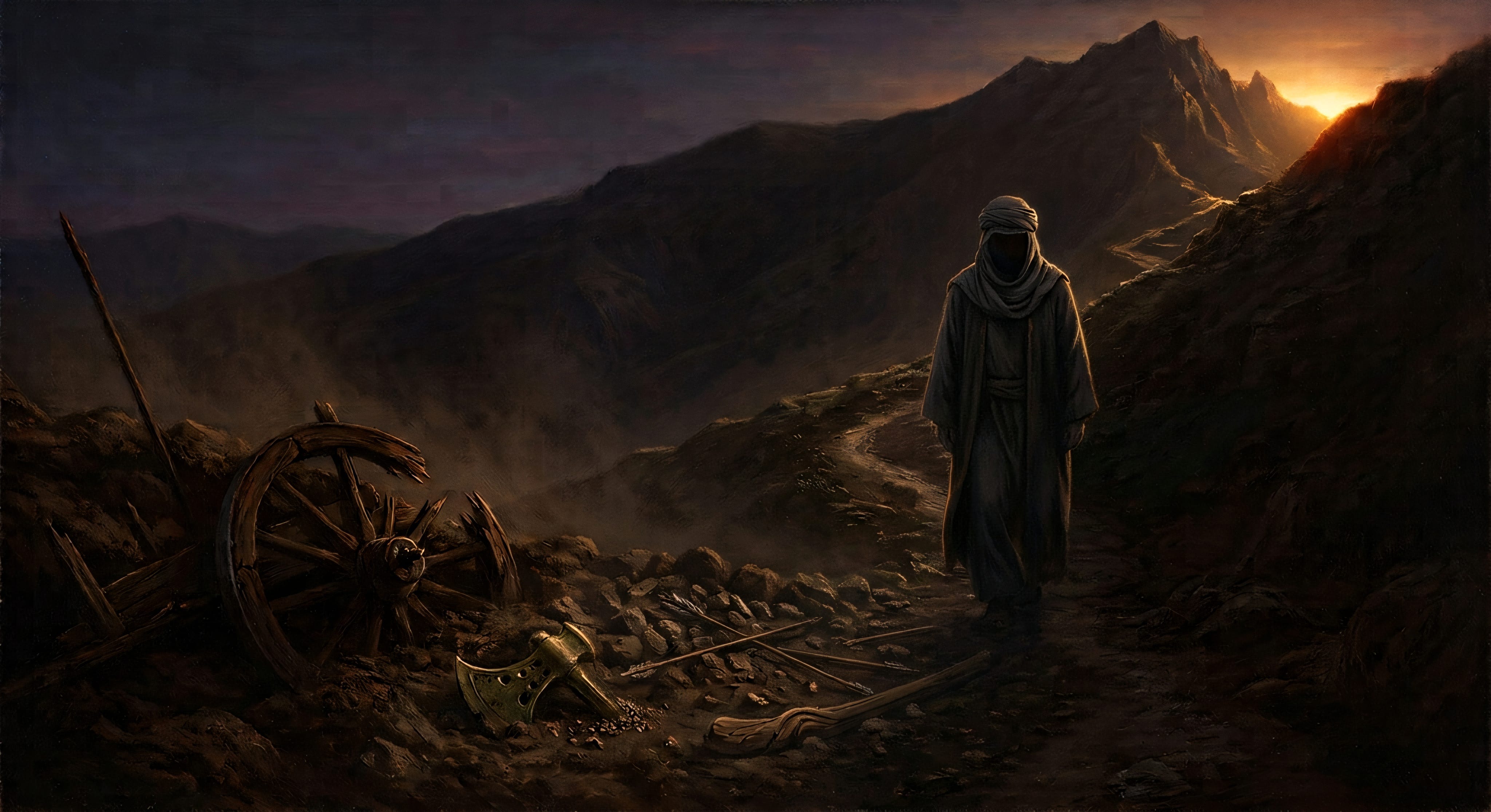
The Clans a Coalition Thought were Worth Defeating First
Rephaim shows up in Genesis 14 like it needs no introduction, and for two centuries of readers who no longer had the clans in front of them, it hasn’t gotten one. The word gets absorbed into English translations as “giants” and left there, a background detail explaining why the war sounded impressive. But the term is doing more work than that single gloss can carry, and if we let it pass by uninspected, we lose something the rest of the Old Testament keeps building on.
Og of Bashan gets called the last of the Rephaim. Goliath’s line traces back through a similar cluster of names. The conquest narratives keep circling back to clans described in the same terms Genesis 14 just used for the coalition’s first targets. None of that lands with its full weight if the word Rephaim stays a vague synonym for “big” in the back of your mind.
So before the war resumes its shape and before Melchizedek’s blessing lands with its full force, we need to know who these clans actually were, what evidence exists outside the biblical text, and where that evidence runs out and interpretation has to take over honestly.
If you’re reading this in email, be aware that the text is likely to cut off without warning. For a smoother reading experience and all the features Substack has to offer (including audio voiceovers of my posts), you can go HERE or download the app.
Kevin: What the Greek Did With It
Lawrence is right that the word gets flattened. I want to push on where that happened, because it was not in English, and it was not an accident.
Two hundred years or so before Christ, Jewish translators in Egypt sat down with the Hebrew Scriptures to render them into Greek in the first part of the work that has come down to us as the Septuagint or LXX.
They faced the same problem we do. They had a word in front of them that their readers would not recognize, attached to peoples who no longer existed, in a language those readers no longer spoke. They had to decide what to say.
At Genesis 14:5 they decided to interpret. Where the Hebrew names a clan, the Greek reads that Chedorlaomer struck down the gigantas, the giants. Not a people. A category.
That is the decision Lawrence is complaining about, made in Alexandria, roughly two thousand years before any English Bible existed.
But here is what makes it interesting rather than annoying. They did not do it consistently. Not even close.
They transliterated. In Deuteronomy 2:11, 2:20, 3:11, and 3:13, and again in Joshua 15:8, the Greek simply carries the Hebrew sound across and leaves it alone. Rephaim stays Rephaim. The translator hands the reader an untranslated name and declines to explain it.
They said giants. Genesis 14:5, and again in 1 Chronicles 11:15 and 14:9.
They said Titans. Twice, at 2 Samuel 5:18 and 5:22, the Valley of the Rephaim becomes the Valley of the Titans. Read that again. A Jewish translator working in Egypt reached into Greek mythology and pulled out the name of the primordial giant generation that warred against the gods of Olympus, and used it for a valley outside Jerusalem.
One caution before you go looking for it. If you open Brenton at those two verses you will not find the word. He gives you the valley of the giants both times, and the Titans are sitting underneath, in the Greek he was translating from. Hold onto that. It comes back.
They said earth-born. In Proverbs the word becomes gegeneis, the earth-born, which in Greek carries its own freight of giants sprung from the ground.
Four strategies. And now the part that ought to stop you.
Some of these are the same event.
Second Samuel 5 and First Chronicles 14 narrate the same battle, David against the Philistines in the same valley. The Greek of Samuel calls it the Valley of the Titans. The Greek of Chronicles calls it the Valley of the Giants.
Second Samuel 23 and First Chronicles 11 narrate the same incident, the three mighty men breaking through Philistine lines while the enemy camps in that same valley. The Greek of Samuel transliterates and leaves the word standing. The Greek of Chronicles calls them giants.
Same valley. Same wars. Three different answers.
This is not corruption, and it is not carelessness. It is what happens when a word is genuinely hard and a translator has to answer anyway. The Hebrew could afford to leave the question open, because Hebrew readers inherited the ambiguity along with the word. Greek readers had no such inheritance. Somebody had to tell them something.
So the Hebrew preserves a word that resists resolution. The Greek preserves a record of people trying to resolve it, verse by verse, book by book, not always agreeing with each other.
I want to be careful about what I am claiming here, because this is the kind of place where it is easy to overreach. I am not saying the Greek tells us what the Rephaim were. The variation is evidence that ancient readers found the term as difficult as we do. That is worth knowing on its own, and it is worth more than a tidy answer would be.
What it does mean is that when your English Bible prints “giants” in one verse and “shades” in another and “Rephaim” in a third, that is not modern translators being sloppy. That is a two-thousand-year-old argument still going on, and your Bible is a participant in it.
There is a fifth rendering. It is the strangest of them, and it bears directly on something Lawrence is about to raise, so I am going to hold it until he gets there.
Lawrence: The Terminology Map
Genesis 14 doesn’t hand us one name. It hands us several, and they aren’t interchangeable, even though English translations often flatten them toward the same effect.
Before we map those names, one thing needs to be said plainly, because it shapes how you read every occurrence that follows. The word Rephaim carries a double identity in the Hebrew Bible, and which identity you meet depends entirely on what kind of literature you’re standing in.
Open a historical narrative, Genesis, Numbers, Deuteronomy, Joshua, and the Rephaim are flesh and blood: an aboriginal people of unusual size and strength, encountered on battlefields and displaced from real territory. Open a poem or a prophecy instead, and the same word describes something else entirely: the spirits of the dead, stirring in the underworld. Same term. Two registers. A reader who doesn’t clock the shift will flatten one meaning into the other and lose the strangeness the text is actually preserving.
Rephaim is the term used in Genesis 14:5, struck at Ashteroth-karnaim. The name recurs across the Old Testament attached to a scattered set of peoples: inhabitants of Bashan under Og, a clan connected to the Valley of Rephaim near Jerusalem, and, in the poetic register just described, a term for the shadowy dead. Bashan itself carries the weight of this history in its own name. Deuteronomy calls the region outright “the land of the Rephaim,” and Og, its king, gets identified in Deuteronomy 3:11 as the last of that remnant.
The verse doesn’t stop at the title. It hands us a measurement: an iron bedstead nine cubits long and four cubits wide, something in the range of thirteen and a half feet by six. Whether that’s a literal resting place or a ceremonial object built to broadcast a dead king’s stature is a live question. Either way, the text wants the number remembered. That range alone tells you the word was doing more than one kind of work across Israel’s history.
Anakim appear later in the conquest narratives, most memorably in Numbers 13, where the spies return from Canaan describing men whose size made the Israelites feel like grasshoppers by comparison. Deuteronomy 2:11 makes a direct connection worth sitting with. Speaking of the Emim, it says that they too were counted as Rephaim, the same way the Anakim were, though the Moabites knew them under their own local name instead.
Emim is exactly that Moabite name for the same or a closely related group, described in Deuteronomy 2:10-11 as a people great and many, and tall as the Anakim.
Zamzummim shows up in Deuteronomy 2:20-21, this time as the Ammonite name for a people also reckoned as Rephaim, described the same way: great, many, tall.
Zuzim, struck at Ham in Genesis 14:5, is widely taken as an earlier or variant name for the same cluster, though the text doesn’t spell out the equivalence as directly as it does for the Emim and Zamzummim.
Lay these five names side by side and a pattern emerges that Deuteronomy itself points to directly. This isn’t five unrelated peoples who happened to share a physical trait. It’s one phenomenon, described under different regional names by different neighboring nations, each of whom apparently had their own word for the same reality living on their borders. The Hebrew text keeps the local names distinct, because it’s recording history region by region, encounter by encounter. But it also keeps telling us, plainly, that these are the same kind of people under different labels.
Kevin: The Tablet That Names the Place
Lawrence is going to walk you through Ugarit properly in a few pages. I want to jump ahead of him for about sixty seconds, because there is one tablet that lands directly on the verse we just read, and it does not get brought up nearly often enough.
Genesis 14:5 does not just say the coalition struck the Rephaim. It says they struck the Rephaim at Ashteroth-karnaim.
Hold that place name.
Among the tablets recovered from Ugarit is one catalogued as KTU 1.108. It opens by naming a figure called Rapiu, and then it tells you where he sits. He dwells in Ashtaroth. He rules in Edrei.
Now open Deuteronomy 1:4. Og, king of Bashan, the last of the Rephaim, dwelt at Ashtaroth and at Edrei.
The same two cities. One pair named on a clay tablet from the Syrian coast, the other pair named in the Hebrew Bible, attached to the same region and the same category of being.
I want to be careful here, because this is exactly the sort of overlap that invites more weight than it can carry. Who Rapiu actually is remains disputed. Scholars have proposed the god El, the god Milku, Baal, a deity in his own right, and the reigning king under a divine title, and the argument has not been settled by anyone. I am not going to tell you the tablet identifies Og’s god.
But the geography is not disputed, and it does not require interpreting. Two cities, named together, in both bodies of literature. Whatever else the Rephaim were, Israel and Ugarit put them in the same place.
Lawrence: The Post-Flood Remnant Reading
Why would multiple, unrelated regions all be dealing with the same kind of outsized, threatening clan in roughly the same era?
Michael Heiser’s reading, laid out most fully in The Unseen Realm, argues these clans are best understood as a post-flood remnant connected to the Genesis 6 Nephilim tradition, populations whose origin the text traces back to that earlier, deliberately unresolved episode rather than treating them as an ordinary ethnic group that simply grew large through diet or genetics.
On this reading, the flood didn’t fully erase what Genesis 6 describes. Pockets of that same lineage persisted, scattered into the regions Israel would later have to displace, which is why the conquest narratives keep returning to the same handful of names in different geographic clothing.
I find this reading compelling, not because it resolves every question, it doesn’t, but because it’s the reading that actually accounts for the pattern instead of explaining it away. A purely naturalistic account, tall clans, nothing more, has to treat the Genesis 14, Numbers 13, and Deuteronomy 2 material as coincidental repetition. The post-flood remnant reading treats the repetition as the point. Genesis 6 raises a disturbing question and then goes silent on it. The Rephaim material scattered through Genesis, Numbers, and Deuteronomy is the closest the text comes to circling back.
The Ugaritic Background
There’s a second body of evidence worth putting on the table, not because it should drive the interpretation, but because responsible handling of the term requires knowing it exists.
Ugaritic texts, from the ancient city of Ugarit on the Syrian coast, use a term rendered rpum, cognate to the Hebrew Rephaim, in a very different context: venerated royal dead, ancestral kings invoked in ritual and remembered with something close to reverence. This is a real and separate strand of ancient Near Eastern usage, and it’s tempting to let it do more interpretive work than it should, treating the Ugaritic material as the key that unlocks what Genesis 14 “really” means by the term.
The Hebrew root underneath the word adds a strange wrinkle to that reverence. R-Ph-A, the consonants underlying Rephaim, is the same root that gives Hebrew its ordinary verb for healing. It’s the root standing behind Exodus 15:26, where the Lord tells Israel that He is the one who heals them.
That’s not a coincidence a careful reader should wave off. It’s given some scholars grounds to argue that the ancestral kings behind the Ugaritic rpum, and by extension the Hebrew Rephaim, may have originally carried a reputation for a kind of power ancient people associated with healing or blessing, the sort of thing you’d expect a community to ascribe to venerated dead royalty precisely because it elevated them past ordinary mortality.
A name built on a root meaning “to heal,” attached to kings a coalition thought worth defeating first, is a strange enough overlap to sit with rather than explain away.
The Ugaritic rpum material illuminates how the term functioned in a neighboring culture’s religious vocabulary. It doesn’t override what the Hebrew text is plainly doing in Genesis 14, Deuteronomy 2, and Numbers 13, which is naming a physically imposing, historically real people group encountered on Israel’s borders. The Ugaritic evidence tells us the word Rephaim carried weight and resonance across the ancient Near East beyond a simple ethnic label. It doesn’t tell us Genesis 14 is secretly describing ritual ancestor veneration instead of a war.
Kevin has considerably more to say about that root than I do, and about whether these are even the same word to begin with. He says it next.
If you found this study enlightening, restacking is the most effective way to share it. But you can also share it directly with anyone you know who needs to see the mysteries of Genesis 14
Kevin: Is It Even the Same Word?
Lawrence has been saying rpum and Rephaim are cognate, and that is true. But I want to slow down on what that actually means, because there are three spellings floating around this conversation and readers understandably assume they are three different things.
They are not. They are one word.
Start with what is physically on the clay. Ugaritic was written in an alphabetic cuneiform that records consonants and almost nothing else. The scribe pressed four signs: r, p, aleph, m. That is the whole word. Rpum.
Rapiuma and Rapa’uma, the forms you will meet in the scholarly editions, are modern attempts to say those four signs out loud. Simon Parker’s volume prints Rapiuma. Dennis Pardee’s prints Rapa’uma. They are disagreeing about vowels the script never recorded in the first place. Neither one is a fuller or more complete version of the other.
Here is the part I find genuinely lovely. Ugaritic has three separate signs for aleph, one for each vowel that can follow it. Which means the spelling preserves the case ending, and you can watch the word decline across the corpus.
Rpu is the nominative singular. That is the figure on the tablet I jumped ahead to mention, the one who sits in Ashtaroth.
Rpi is the genitive. It shows up as the standing epithet of Daniel in the Aqhat legend, mt rpi, man of Rapiu.
Rpum is the nominative plural. Rpim is the oblique plural.
A word about those four labels, because they are doing real work and not everyone knows off the top of their head what they mean.
English used to mark its nouns for the job they were doing in a sentence, and then it mostly stopped. We kept the habit in exactly one place. Pronouns.
You already do this without noticing. He saw the king. The king saw him. His house. Same man, three shapes, and the shape reports what he is doing in the sentence rather than who he is. Nobody had to teach you that, and nobody gets it wrong (usually).
That is all a case is. A change in the shape of a word that tells you its job.
Nominative is the subject form. The one doing the acting. He.
Genitive is the possessive and relational form, the one English usually handles with the word of. His, or of him. Which is why mt rpi means man of Rapiu. The noun itself is wearing the of.
Oblique is a catch-all, and Ugaritic is the reason we need one. In the plural, Ugaritic does not bother to keep “of them” separate from “them.” It has one form for the subject and one form for everything else, so rather than list what that second form covers, grammarians just call it oblique.
Line them up against the pronouns and the whole thing stops sounding technical.
Rpu is he. Rpi is his. Rpum is they. Rpim is them.
Four shapes of one word, and the shapes are the argument. If these were four unrelated words that happened to resemble each other, they would not fall into the pattern that every case language falls into. They fall into it because they are one noun, declining, the way nouns do.
Four forms, one noun, root r-p-aleph. Hebrew let the case system go entirely, so rephaim stands where Ugaritic still keeps the forms apart. Same consonants. Same root. Same masculine plural. Phoenician has it as well, rp’m, carved into the sarcophagus of a king of Sidon.
So yes. Same word. Three spellings, one of them ancient and two of them ours.
And now the caution, because this is where arguments like this one usually go off the deep end.
Cognate is not synonym.
A shared word does not oblige two literatures to mean the same thing by it. English ghost and German Geist come down from one ancestor and do very different work. The shared word is the single strongest link between Ugarit and the Hebrew Bible on this subject. But it is still a link and not an equation.
Here is the concrete case, and it matters for everything Lawrence has been building.
In the Hebrew Bible the Rephaim are repeatedly described as physically large. Deuteronomy 2 says great and many and tall as the Anakim, and says it twice. Deuteronomy 3 hands us Og’s bedstead in cubits. Numbers 13 has the spies coming back talking about grasshoppers.
In the Ugaritic tablets, the rpum are never described as large. Not once. Not their height, not their strength measured against anyone else, not a single dimension anywhere in the corpus. The size is a biblical datum. It is not corroborated at Ugarit and it is not contradicted there either, because the tablets simply do not raise the subject. Anyone who tells you the Ugaritic evidence shows us giants has not read it. Or at least hasn’t read it closely enough.
What the tablets do give them is rank. They are called warriors of Baal and warriors of Anat. They are called the eternal royal princes. Dead kings, honored.
Which brings me back to Isaiah.
Isaiah 14 is the passage where the king of Babylon goes down to Sheol and the dead get up to meet him. The Hebrew calls them rephaim, and then, in the very same breath, tells you who they are: all who were leaders of the earth, all who were kings of the nations.
The Hebrew glosses its own word: Dead kings.
That is the Ugaritic sense, arrived at independently, sitting inside the Hebrew Bible with no help from anybody.
And the Greek translators, holding that verse, wrote gigantes. Giants. In a passage where the Hebrew has just told them, in the next clause, that it means dead kings.
Now go and look that up in Brenton, and you will not find the word giants anywhere in it. Sir Lancelot Brenton, whose nineteenth-century English rendering of the Septuagint I am quoting throughout this series, gives you “all the great ones that have ruled over the earth.” He has the Greek in front of him. The Greek says giants. He writes great ones instead, because giants did not fit what the verse was plainly doing.
Then turn to Job 26:5, and the same man translates the identical Greek word as giants without a flicker of hesitation. “Shall giants be born from under the water.”
Same translator. Same Greek word. Two different English answers, chosen by context, inside one volume.
Remember the Titans I asked you to hold onto. Brenton buries those too, and for the same reason.
So the argument did not end with the translators in Alexandria. It did not end in the second century, as we are about to see. It was still going in the nineteenth century, in the English Septuagint sitting on my desk, where one man looking at one Greek word made two different calls about it in two different books and left both of them standing.
We have not resolved this. We have only added translators to it.
Kevin: The Fifth Rendering
This is the one I held back.
A moment ago Lawrence heard the healing root inside the word and found it strange enough to sit with rather than explain away. He is not the first person to have that reaction. He is roughly twenty-two centuries late to it.
Twice, the Greek translators looked at rephaim and rendered it iatroi. Healers. Physicians.
Psalm 88:10 in our Bibles, 87:11 in the Greek numbering, asks in Hebrew whether God works wonders for the dead, whether the shades rise up to praise Him.
The Greek asks whether God works wonders for the dead, or whether physicians raise them up to praise Him.
That is Brenton’s English again. Where the Greek side sounds older than the Hebrew beside it, that is his Victorian phrasing and not anything in the Greek.
Isaiah 26:14 does the same thing. The Hebrew says the dead do not live and the shades do not rise. Brenton’s Greek says the dead shall not see life, and physicians shall by no means raise them up.
So Lawrence’s instinct has ancient company. Readers who knew Hebrew as a living language, reading the consonants he is reading, heard healers.
And the argument did not stop
The five renderings we just walked through happened in the third and second centuries before Christ. Translators in Egypt, working on the Hebrew Scriptures, deciding what to do with a word their readers would not recognize.
Here is what I find remarkable. They did not settle it, and four hundred years later people were still arguing.
By the second century after Christ, Greek-speaking Jews were producing entirely fresh translations of the Hebrew Bible. Not revisions of the Septuagint exactly, though sometimes that too, but new work, done because the old Greek no longer satisfied them. Three of these translators are known by name. Aquila, Theodotion, and Symmachus.
We have their work because of Origen. Sometime in the early third century he compiled what is called the Hexapla, from the Greek for sixfold, a massive arrangement laying six versions of the Old Testament in parallel columns so a reader could see them against each other at a glance. The Hebrew. The Hebrew written out in Greek letters. Then Aquila, Symmachus, the Septuagint, and Theodotion.
Sadly, it has not survived intact. What we have of Symmachus comes from fragments, marginal notes copied by later scribes, and a Syriac translation of Origen’s Septuagint column made in the seventh century. So everything below is a scholarly reconstruction rather than a manuscript you can pick up.
That matters and I want you to know it going in.
With that said.
Symmachus reached the Rephaim passages and rendered the word in some places as theomachoi. Which means God-fighters. Those who make war on God.
He does it at Job 26:5, at Proverbs 9:18, at Proverbs 21:16, and in Psalm 88, at the verse where the psalmist asks whether the dead rise up to praise the Lord.
Now hold that last one next to what we discussed a moment ago, because Psalm 88 is the verse where the Septuagint translators, reading the same Hebrew consonants, wrote something almost exactly opposite.
One tradition looked at that word and saw healers.
The other looked at it and saw those who war against God.
Four hundred years apart, both working from Hebrew, both Jewish, both serious. And they land on opposite ends of the universe.
I am not going to tell you one of them was wrong. I do not think the evidence lets me, and I am not convinced the question was ever meant to be closed. What I will say is that if the word had been obvious, none of this would have happened. Six centuries of translators do not disagree this violently about a word that has a plain meaning.
Which is worth remembering the next time your English Bible prints “giants” in Genesis 14 as though the matter were settled.
The Difficulty
Now the hard part, and I think it is the honest one.
Michael Heiser, whose reading of the Rephaim as a post-flood remnant Lawrence laid out a few pages ago, does not think this helps. He notes the two iatroi renderings and sets them aside, because the Greek handles the word so inconsistently everywhere else that this may be nothing more than interpretive guesswork. He goes further. There are no instances anywhere, in the Hebrew Bible or in the Ugaritic material, where these beings are actually portrayed as healers. Not one.
That is a strong statement, and it comes from the source most likely to want it to go the other way.
Theodore Lewis, who translated the Ugaritic Rephaim texts for the standard scholarly anthology, lists five things scholars have proposed these beings were: minor deities, heroic warriors, a tribal group, the shades of the dead, or some combination of those. Healers do not appear on the list.
So where does that leave the root?
Right where Lawrence put it, I think, but held a little more loosely. The consonants really do sit inside Hebrew’s ordinary verb for healing. Ancient translators really did hear it that way, twice. And that hearing produced a reading nobody has been able to support from how these beings actually behave anywhere in the literature.
Which tells us something, though not the thing we wanted. It tells us the word was already hard in the third century before Christ. Men who spoke the language, working with the text in front of them, could not agree on what it meant. They tried giants. They tried Titans. They tried earth-born. They tried healers. And sometimes they gave up and wrote the sound down without explaining it at all.
We inherited the difficulty honestly. Both traditions kept it for us: the Hebrew by preserving the word, the Greek by preserving the arguments about it.
Lawrence: The Shades of the Dead
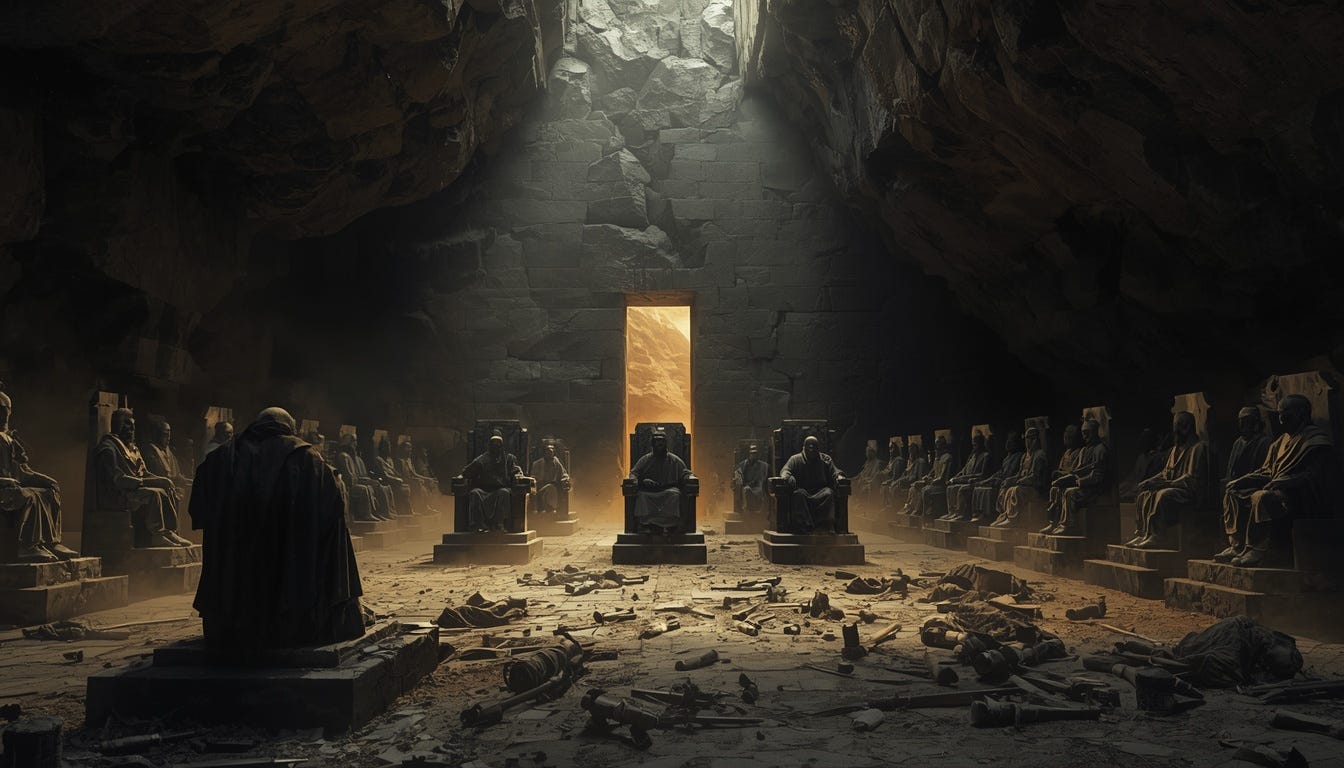
Everything so far has kept the Rephaim on solid ground, a real people, encountered in real territory, described in the plain prose of historical narrative. Move into the Psalms, Proverbs, and the prophets, and the ground shifts under the word without warning.
Isaiah 14 mocks the fallen king of Babylon by picturing the underworld itself reacting to his arrival. Sheol stirs to meet him. The Rephaim, the text says, rise from their thrones to greet him, the very ones who once ruled nations now revealed as nothing more than shadows waiting in the dark. Psalm 88 asks God directly whether He works wonders for people in this state, whether the Rephaim can rise up and praise Him the way the living do.
The implied answer is no. They can’t. They’re past the reach of praise. Proverbs 2 warns that the path of the adulteress sinks down toward death, toward the Rephaim, using the same word one more time as a synonym for the grave itself. Job 26:5 adds a fourth witness, picturing the Rephaim trembling beneath the waters, subject to God’s authority even from inside the deep.
Four separate poetic voices, four separate contexts, and the word means the same thing in each: not a nation, not a clan, but the weak, voiceless dead in Sheol. Whatever confidence and stature the Rephaim carried in the historical books, the poetic books strip it away completely. A fifth witness makes the same point from a different verse entirely. Proverbs 9:18 warns that the man lured into the adulteress’s house doesn’t realize her guests are already dead, already among the Rephaim, already in the depths of Sheol.
Genesis 6 names the episode all of this traces back to. Sons of God took the daughters of man, and what came from those unions were the Nephilim, described as mighty men of old, men of renown. This is the lineage Genesis 14 later calls Rephaim under a different regional label. Hybrid from the start, the text implies, part human and part something else, and hybrid in death as well as life. They die in the flood, and where a remnant survives, they die again generations later in conquest, clan by clan, the war traced in the piece before this one.
An ordinary human death doesn’t obviously apply to a being that was never ordinary to begin with. If the text’s own internal logic holds, a spirit that entered existence through something other than the normal course of human generation doesn’t necessarily go where normal human spirits go once the body fails. Displaced might be the fairest word for it.
Disembodied, and without a natural resting place.
1 Enoch, outside the biblical canon but read as background even by New Testament writers who allude to it, develops exactly this idea: the spirits of the slain giants become the wandering, harassing spirits that afflict the world after their bodies are gone, forever seeking what they no longer have. Readers who want the fuller Enochic case can find it worked out in a four-part Fallen Watchers series linked below. I’m compressing rather than duplicating it here.
That idea, if it holds, reframes something familiar in the Gospels. When Jesus casts out demons, those spirits don’t behave like generic evil. They beg for bodies. When Legion is driven from the Gerasene man in Mark 5, the spirits don’t ask to simply vanish. They ask to enter a herd of pigs rather than be left without a host. Matthew 8:29 catches something stranger still. The demons ask Jesus if He has come to torment them before the appointed time, as though they already know a reckoning is scheduled and are trying to postpone it. That’s not the language of formless evil.
That’s the language of beings who know exactly what they are and exactly what’s coming.
If the Rephaim of the historical books and the Rephaim of the poetic books, Isaiah 14, Psalm 88, Proverbs 2:18 and 9:18, name one continuous category before and after death, this is the shape that category takes. Living giants on the battlefield. Disembodied, homeless spirits after it. The same beings on both sides of the grave, described from two different vantage points by two different kinds of literature.
Why the Dual Meaning?
That contrast isn’t likely to be an accident of vocabulary, and the Ugaritic material already on the table gives us a plausible reason why.
Feeding the dead wasn’t a metaphor at Ugarit. It had a name, a guest list, and at least once a signed lease.
The name is marzeah. It turns up across the tablets as a drinking society that gathered for ritual feasting, and the archives preserve an actual contract for a marzeah meeting place, which is about as unambiguous as ancient evidence ever gets. A feast held to keep the honored dead satisfied is a form of ancestor worship, full stop, and it’s precisely the kind of practice the God of Israel repeatedly and explicitly forbids. Don’t eat it in mourning. Don’t give any of it to the dead. Don’t lodge among the graves waiting for the dead to answer you.
And here’s the detail that ought to settle any doubt about whether Israel actually faced this. The same word turns up in Hebrew. Amos condemns the marzeah of the sprawlers in Samaria. Jeremiah is told not to enter the house of marzeah at all. You don’t forbid a practice nobody is doing.
Read the biblical Rephaim material against that background and a pattern worth taking seriously emerges. In the historical books, the Rephaim aren’t demigods to be venerated. They’re enemies Israel is commanded to defeat, and does defeat, clan by clan, campaign by campaign. In the poetic books, the same name describes not powerful ancestral spirits capable of blessing or cursing the living, but silent, powerless shades who can’t even praise the God who made them.
Read together, the two portraits do the same theological work from opposite directions. The nations around Israel worshiped their mighty dead as semi-divine ancestors. Israel’s Scripture answers that claim twice: historically, by defeating the Rephaim’s living representatives outright, and poetically, by stripping their dead of any power at all. Neither register leaves room for what the neighboring cultures believed about them.
I find this reading more persuasive than treating the overlap as coincidental homonymy, precisely because it explains why the word survives in both registers instead of splitting into two unrelated terms the way Hebrew usually handles unrelated meanings that happen to share consonants. The polemic makes the shared name necessary rather than incidental. The same word has to carry both blows for the argument to land.
Kevin: What the Specialist Says
I want to put one citation behind what Lawrence just argued, because he reasoned his way to it and somebody else got there with the primary texts open in front of him.
Theodore Lewis is the scholar who translated the Ugaritic Rephaim tablets for the standard English anthology. I mentioned him a few sections back for his list of five things the rpum might have been. Here is what he says in that same introduction, a few sentences later, comparing the two bodies of literature directly.
“The Ugaritic Rapiuma,” he writes, “were perceived to be quite active. They hitch horses, gallop on stallions, ride for three days to a banquet, and dine on what seems to be sumptuous fare.” And then this. “In contrast, the biblical texts argue against ascribing any power to the Rephaim. They may engage in some activity,” he allows, and he points to Isaiah 14. But for the most part they are stripped of any power, and he sends the reader to Isaiah 26:14 and Psalm 88:11 to watch it happen.
Now read that against what Lawrence just said, and notice that the two of them are describing the same thing from opposite ends of the room.
Lawrence arrived at the contrast theologically, by reading the two bodies of literature side by side and asking what the Hebrew text was doing with a word its neighbors used differently. Lewis arrived at it by translating the tablets and then looking across at the Hebrew. Neither man was trying to prove the other one’s point.
That is the kind of agreement worth having. Not two people repeating a single argument, but two different methods landing on the same observation from different directions.
It does not make the polemic reading certain, and Lawrence is about to tell you why. He is right to. But it does mean the contrast he is building on is not something we invented to make the theology come out even. It is visible to a specialist who had no theological stake in it whatsoever.
Lawrence: The Open Question
None of that fully closes the file, and honesty requires saying so.
The polemic reading is compelling, but it’s a reconstruction built from comparative evidence, not a claim the biblical text ever states outright. Scripture never pauses to explain that it’s using one word twice on purpose to answer Canaanite ancestor worship. We’re inferring the strategy from the pattern, and inference, however well-supported, isn’t the same as the text telling us its own intention.
It’s possible the historical and poetic uses really did converge from two separate roots that happened to collide in form, and the theological payoff we’re finding is a genuine implication readers can draw rather than an intention the original writers consciously built in. I don’t think the evidence lets us close that question with total certainty, and I’d rather leave that seam visible than paper over it with more confidence than the sources can bear.
What the terminology map does establish, without needing the shades question resolved, is this: Rephaim, Anakim, Emim, Zamzummim, Zuzim. Five names, one phenomenon, described consistently enough across independent sources that the coalition’s decision to clear them out before ever reaching Sodom stops looking like incidental detail. It looks like the chapter telling us exactly how high the stakes were.
There’s one more piece of evidence this question can’t be separated from, and we’ve been circling it the whole way. It’s time to go back to the Syrian coast and read what’s actually on those tablets.
The Feast Beneath the Sand
In 1929, French archaeologists began digging at Ras Shamra on the Syrian coast, and what came up out of the sand was the port city of Ugarit. Among the ruins sat hundreds of clay tablets, written in a script nobody living had ever seen.
Here’s the part that still gets remarked on in the field. It didn’t take long. Hans Bauer published a solution in 1930, Dhorme and Virolleaud refined it almost immediately, and within a couple of years scholars were reading the tablets with confidence. For a script that came out of the ground cold, that is startlingly fast, and it’s one of the quiet triumphs of twentieth-century Semitic philology.
What the tablets described, once they could be read, was startling in a different way. Feasts held for dead kings. Funerary liturgies naming the royal dead by name. And a body of poetry about something the texts call the Rapiuma.
Among that poetry, scholars identified a specific set of tablets, catalogued as KTU 1.20 through 1.22, that Ugaritologists call the Rephaim texts. They’re not a liturgy, and it’s worth being precise about that, because the popular retellings usually aren’t. The standard English edition prints them under the title Ugaritic Narrative Poetry, and the translator goes out of his way to warn readers against reading a cultic role into the unnamed voice in the text. What they actually are is damaged poems about a banquet. And the banquet is El’s.
It’s El who does the inviting, and he invites them to his own house. Come to my banquet. Set off to my house, O shades. Into my house I bid you. They hitch their chariots, yoke the horses, ride a day and a second, and reach the threshing floors on the third. They eat. They drink. A day, a second, a third, a fourth, a fifth, a sixth, and then the seventh, in the banquet house on the summit, in the heart of Lebanon.
And the poem tells you plainly who’s at that table. Warriors of Baal. Warriors of Anat. The eternal royal princes.
Dead kings, seated at a god’s feast, named as warriors and princes. Whatever else that is, it isn’t a people being remembered fondly at a graveside. It’s a court.
Look around the world and that same shape keeps reappearing. Greek religious practice built entire liturgies around libations poured out to invite the gods down to share what the living had prepared. In West African spiritual systems built around the Orisha and Vodun, the community gathers to feed venerated spirits believed to descend and dwell among the people, the way they did in ages past.
Travel to Haiti or Cuba and the same structure reappears in Haitian Vodou and Santería, where spirits are said to descend and “ride” their human followers, and where fêtes, festivals that can run for days, exist specifically to host them. Brazil’s Candomblé follows the same pattern under a different name.
Now, some of that family resemblance has a plain historical explanation, and it’s worth saying so out loud. Vodou, Santería and Candomblé aren’t independent inventions that happened to land on the same idea. They’re one tradition carried across an ocean, West African religion surviving the slave ships and putting down roots under new names in new countries. That’s history, not mystery, and pretending otherwise would be dishonest about people’s actual past.
What’s harder to account for is why the shape itself is so old and so widespread in the first place: a summons, a feast, an invitation for the dead and the disembodied to come and share a body and a physical experience they no longer have any natural claim to, in exchange for knowledge or healing. That hunger for embodiment isn’t incidental to what these spirits are. It’s the whole point. Scripture is blunt about what that hunger ultimately serves.
“We do not wrestle against flesh and blood,” Paul writes in Ephesians 6:12, but against something older and larger than any single enemy on a battlefield.
Which is exactly why the Great Commission carries the weight it does.
“Go therefore and make disciples of all nations, baptizing them in the name of the Father and of the Son and of the Holy Spirit, teaching them to observe all that I have commanded you. And behold, I am with you always, to the end of the age” (Matthew 28:19-20).
That’s not a suggestion tacked onto the end of the Gospels. It’s a mobilization order for a war that started with Genesis 6 and hasn’t stopped since.
This is the part of that Holy War believers are actually fighting today. Not against giants we slay with a sling and a stone. Not clans cleared out of the Transjordan by a coalition of kings.
And leave the question above exactly where I left it. Unresolved.
Whether the Rephaim of the battlefield and the Rephaim of Sheol are one continuous category is a seam I said I’d keep visible, and I’m keeping it.
The anchor doesn’t depend on it. 1 Enoch says what the spirits of the giants became, and it says it without flinching:
“And the spirits of the giants afflict, oppress, destroy, attack, do battle, and work destruction on the earth, and cause trouble. They take no food, but nevertheless hunger and thirst, and cause offenses.”
Hunger without a mouth. That’s the diagnosis.
And Jesus describes the same creature without citing anybody at all. An unclean spirit goes out of a man, passes through dry places seeking rest, finds none, and then says, “I will return to my house from which I came.” A house. That’s what a person is to it. Legion begs for the pigs rather than be sent away with nothing, and the request tells you what the fear actually is. Not destruction. Vacancy.
The fight now is for people, not against them, wherever a table is still being set for something that wants them for a house. Still hungry. Still seeking a body. God doesn’t want His people watching from the sidelines.
We’re still on the battlefield.
The Fallen Watchers Complete Series:
Thank you for reading.
Part 3 drops Wednesday on Kevin’s page, where we’ll pick up with Melchizedek’s entrance in Genesis 14. Then Part 4 returns next Saturday here on Deeper Still.
See you Wednesday. The breadcrumbs are getting more interesting.
Lawrence
Deeper Still
Where should we dig next? Leave a question, passage, or topic in the comments and let’s follow the breadcrumbs.
Keep Deeper Still Going
Deeper Still is free to read, and it always will be. If this work has been meaningful to you, there are a few ways you can help support it:
Get access to all upcoming ebooks and support the work for the year ahead.
Your monthly support helps me continue creating Deeper Still and reaching people who may not yet know they need it.
If something you read here blessed you and you’d like to give directly, you can Buy Me a Coffee.

Thank you for being part of the Deeper Still community. Your support helps me keep digging, keep asking questions, and keep bringing the things I uncover back to the table.
Thank you for being part of this journey, your support makes this work possible.
© 2026 Deeper Still. All rights reserved.
You have given me A LOT to think about❣️This is deeper than I’ve thought about before but fascinating- thank you Lawrence for sharing this with me and God bless you for your work, AMEN and HALLELUJAH‼️🙏✝️🙌❤️😻
Oh my goodness. What an eye opening recitation of text, language and interpretive analysis. I am going to have to sit with this. It answers so many questions - while creating more! Delicious! Ty so much for this work! 🙏🏻 Looking forward to 3 and 4!